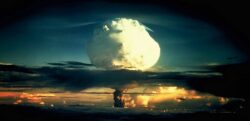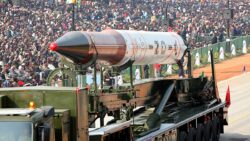
© Bulletin of the Atomic Scientists
By Ms Debalina Ghoshal1
Desire in economics is a wish to achieve a goal. Want in economics is a desire that could be fulfilled. Every want has once been a desire, but not all desires translate into want. Thus, if a wish is not supported by credible actions and steps taken to achieve it, the wish remains a desire and does not have the capability to fructify into want. To be able to transform material desires into wants, financial support for the same is required. Even though the logic of nuclear disarmament is intangible in nature, the process has to go through tangible mechanisms that would require finance. It is in this context that the article aims to highlight how nuclear disarmament could only remain a desire for states which do wish to spend on the disarmament process. This article becomes even more imperative as global spending on nuclear weapons programs is increasing instead of reducing despite the efforts to educate on nuclear fall-outs and catastrophes.
The paradigm
States operating in the international system operate in an anarchical world order with the absence of a supranational body to govern them. This anarchy is coupled with the issue of the security dilemma2 that a state is subjected to, and the reason that determines a state’s actions in both hard and soft power decision makings and policy implementations. In hard power prowess strategy, this security dilemma becomes a decisive factor for states to decide on arming or disarming a particular weapon system. In the case of nuclear weapons, such dilemmas become more complex. In 2024, global spending on nuclear weapons owing to the security dilemma was USD100 billion and this spending is reported to increase in the future3. This complexity determines whether a state is willing to incur the cost of disarmament or whether nuclear armament remains a fruitful choice. Ironically, nuclear disarmament is the only viable and inexpensive solution to nuclear risk reduction: if there is no bamboo, there will be no flute to play. But only when a state is willing to incur the cost of disarmament could it transform the desire to disarm into want to disarm.
For instance, South Africa gave up the path of nuclear weapons and missile programme when it found no immediate threats looming from the Soviet Union near its territory. In 1991, South Africa finally acceded to the Non-Proliferation Treaty (NPT) and also signed a safeguards agreement with the International Atomic Energy Agency (IAEA). South Africa built and destroyed nuclear bombs that cost around USD 400 million4. In 1996, South Africa also joined the Treaty of Pelindaba that pledges to keep the African continent as a nuclear weapons-free zone (NWFZ) and it also signed the Comprehensive Test Ban Treaty (CTBT)5. During the Cold War, Ukraine was a republic of the erstwhile Soviet Union. It hosted the third-largest nuclear arsenal in the world as Soviet nuclear warheads and missiles were stationed in Ukraine. However, with the breaking up of the Soviet Union and the end of the Cold War in 1991, Ukraine was poised towards the path of disarmament of nuclear weapons through the Nunn-Lugar Threat Reduction Cooperation programme6. In this programme, the United States would financially assist Ukraine to decommission its nuclear weapons while Russia would assist in taking back its arsenals. The cost of nuclear armament and its maintenance was higher for Kyiv than nuclear disarmament. Ukraine’s financial status was in doldrums and hence, during the disarmament process, receiving 275 USD million dollars for strategic bombers TU-160 and TU-95MS and cruise missiles like X-55 and other equipment from Russia was viewed as a boon7.
In February 2026, the New START Treaty, a treaty to reduce strategic nuclear arsenals between the United States and Russia, expires. Since the inception of the START legal arrangement, both the parties have allocated a part of their budgets for the elimination of the required strategic nuclear arsenals. However, Russia also spends heavily on a nuclear modernisation process. In 2024, there were reports that Russia spent USD 8.1 billion on nuclear modernisation process8.
Ironically, states have showed a peculiar syndrome of funding disarmament processes but not participating in them. Such a syndrome could be termed as a ‘partial participatory syndrome’ (coined by the author) in which states fall short of participating in disarmament mechanisms but participate willingly in funding legal arrangements. For instance, the United States and China fund the Comprehensive Test Ban Treaty Organisation (CTBTO), but have not yet ratified the CTBT though they have signed the same. India, on the other hand, finds the treaty discriminatory and hence, has not signed the same, neither does it fund the CTBTO. On the other hand, nuclear-weapon states (NWS) like France and Britain have showed a ‘participatory syndrome’ (coined by the author) in which they have not only funded the CTBTO, but have signed and ratified the treaty. They also support most nuclear-weapon free zones (NWFZ). According to French government9,
France is party to most of the protocols to the treaties creating NWFZ. In addition to the Antarctic Treaty of 1959 (providing complete demilitarization), France is party to the protocols to the Treaty of Tlatelolco (ratified in 1974 and 1992), the Treaty of Rarotonga (ratified in 1996), the Treaty of Pelindaba (ratified in 1996) and the Treaty of Semipalatinsk (joined in 2014) creating zones free of nuclear weapons respectively in the Latin America and the Caribbean, the Pacific, Africa and Central Asia. France also recognized the status of Mongolia as nuclear-weapon-free zone in 2012.
States under extended nuclear deterrence strategy, like Germany, South Korea and Japan also financially contribute to CTBTO and also signed and ratified the treaty. The author defines ‘participatory syndrome’ as a syndrome in which states are not only willing to provide financial and technical expertise for nuclear disarmament, but also willingly participate in such processes that promote nuclear disarmament.
India desires for nuclear disarmament which is particularly mentioned in its nuclear doctrine, but this desire has not transformed into a want owing to India’s own immediate threat perceptions and global developments that prevent it from allocating a budget for nuclear disarmament. However, India’s lackadaisical approach of allocating a budget for nuclear disarmament is because it considers the global legal arrangements for nuclear disarmament as unjust while it aims to focus on nuclear disarmament supporting any convention of prohibition of nuclear weapons under the Conference on Disarmament (CD) which it considers as main platform for a global nuclear ban treaty10. This kind of syndrome is defined by the author as ‘coveted approach syndrome’ in which the state neither participates nor funds such mechanisms but are willing to participate in global platforms for nuclear disarmament that it feels relevant for its security needs and prestige. For such states, nuclear disarmament process, despite the willingness to participate in one, remains a coveted dream owing to the fact that its own belief systems do not oblige with the global mechanisms. This is also the same stance that Pakistan maintains: Islamabad could only engage in disarmament talks that fall under the purview of the Conference on Disarmament. It has expressed its dissatisfaction over the Fissile Material Cut-off Treaty but was confident of joining the treaty if existing stockpiles were also included in the treaty to reduce disparities among nuclear powers.
Russia, on the other hand, was a signatory to the CTBT and also ratified the same. Russia also provided funding for the CTBTO. However, in 2023, Moscow revoked its ratification of the treaty and hence now neither funds the treaty nor participates in it. This kind of action in which a state neither funds the process of disarmament nor participates in it could be termed as ‘refraining syndrome.’ A state like North Korea also refuses to participate in any nuclear disarmament process and does not provide funding for any nuclear disarmament mechanism. Instead, despite being a sanctioned economy, in 2022, there were reports that North Korea had spent USD 1.6 billion on its nuclear weapons programme for over fifty years11.
Nevertheless, these syndromes will vary for states from one legal arrangement to another. For instance, both the United States and Russia are participants to the Non-Proliferation Treaty (NPT), a key cornerstone for nuclear disarmament thereby, displaying a ‘participatory syndrome’. The United States also has customary arrangements like the Non-Proliferation and Disarmament Fund (NDF) and Cooperation Threat Reduction (CTR) programme for nuclear disarmament in which it participates to ensure nuclear safety and security globally.
Another factor that prevents states from converting their nuclear disarmament desire into a want is the concern regarding other states possessing a nuclear programme for peaceful purpose. Article IV of the Nuclear Non-Proliferation Treaty (NPT) provides its States Parties with the “inalienable right” to pursue nuclear energy programmes for peaceful purposes. However, uranium enrichment and spent fuel reprocessing processes could always lead a state to pursue nuclear weapons. Even a state which can pursue low enriched uranium (LEU) could also enrich uranium to high enriched uranium (HEU) and build nuclear weapons.
States in all regions of the world pursue nuclear energy programmes as a viable source of energy, and hence, nuclear disarmament could become a difficult task to achieve for states running nuclear energy programmes due to the concern that these states could develop nuclear weapons. One such example is Iran that has been pursuing an officially peaceful nuclear programme but has been continuously accused of a ‘possible military dimension’ to this programme. Iran refused to give up on its right to uranium enrichment as part of its nuclear energy programme. Iran also refused to include ballistic missiles, a crucial delivery vehicle for nuclear warheads, in its nuclear talks.
Conclusion
The desire for nuclear disarmament from nuclear-armed states could only turn into a want for nuclear disarmament when the want for nuclear weapons diminishes. As long as the states’ want for nuclear weapons remains high, the want for nuclear disarmament among such states would remain inversely proportional to the former, that is the possibility of achieving nuclear disarmament globally would be a utopian achievement.
1 Advisor, Indian Aerospace and Defence News; Advisor, Ultimate Defence; Author of the Book: The Role of Ballistic and Cruise Missiles in International Security. In this article the author expresses personal views that do not necessarily coincide with the positions of IDN.
2 In international relations, the security dilemma is when the increase in one state’s security (such as increasing its military strength) leads other states to fear for their own security (because they do not know if the security-increasing state intends to use its growing military for offensive purposes). See Jervis, Robert (1978). “Cooperation Under the Security Dilemma”. World Politics. 30 (2): 167–214.
3 “Global Spending on Nuclear Weapons topped $100 billion in 2024,” ICAN, 13 June 2025, <Global spending on nuclear weapons topped $100 billion in 2024 – ICAN>.
4 Zondi Masiza, “A Chronology of South Africa’s Nuclear Program,” The Non Proliferation Review, Fall 1993, <NPR 1.1: A Chronology of South Africa’s Nuclear Program>.
5 “Nuclear Disarmament: South Africa,” NTI, 19 November 2025, <Nuclear Disarmament South Africa>.
6 “Ukraine once had the world’s 3rd largest nuclear arsenal; but gave up its weapons for this,” The Economic Times, 6 March 2025, <ukraine nuclear disarmament: Ukraine once had the world’s 3rd largest nuclear arsenal; but gave up its weapons for this reason – The Economic Times>.
7 “Step-by-Step to Disarmament: Why Ukraine will not be able to restore its nuclear status,” UATOM, 5 June 2025, <Step by Step to Disarmament: Why Ukraine Will Not Be Able to Restore Its Nuclear Status – Uatom.org>.
8 “Russia,” ICAN, <Russia | Treaty on the Prohibition of Nuclear Weapons>.
9 “Nuclear Disarmament,” Ministry for Europe and Foreign Affairs, <Nuclear disarmament – Ministry for Europe and Foreign Affairs>.
10 “Statement by India during the thematic debate on Nuclear Weapons at the First Committee of the UN General Assembly, October 2020, <Welcome to Permanent Mission of India in Geneva>.
11 “North Korea has spent USD 1.6 billion on nuke program over 50 years,” The Asahi Shinbun, 28 September 2025, <North Korea has spent $1.6 billion on nuke program over 50 years | The Asahi Shimbun: Breaking News, Japan News and Analysis>.