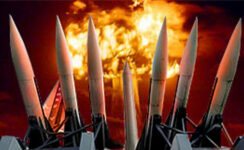
© Shutterstock
by Debalina Ghoshal¹
On 2 March 2026, France’s President Emmanuel Macron announced that France revised its nuclear deterrence strategy and offered “forward” nuclear deterrence to interested European countries. While being careful not to transform the traditional French nuclear doctrine giving the Head of State a monopoly on the decision to use nuclear weapons, the President has announced shifts in postures and strategies that were meant to strengthen its European security. In particular, the President has stated that Paris would focus on both qualitative and quantitative “strengthening” of its nuclear weapons, citing France’s threat environment that has now expanded, but keeping “the size of its arsenal in strict accordance with the operational effectiveness of [its] nuclear deterrent.”
He has also laid stress on the fact that including European states in its “vital interests” would be different than the “nuclear umbrella” protection provided by the United States within NATO or bilateral agreements with other states (Australia, Japan, South Korea). To offset any criticism that France could invite strategic destabilisation, the President has been careful to restrict this “forward” deterrence to the potential recourse to strategic nuclear weapons, considering that it does not possess “tactical” nuclear weapons (TNWs). Indeed, US extended nuclear deterrence includes the potential use of TNWs (around a hundred B-61 gravitation bombs stationed in five NATO nations: Belgium, Germany, Italy, the Netherlands, and Turkey). Such a move by the President is clear aiming at signalling to Russia the capability of an autonomous deterrent in Europe in case the US would abstain to cater to European security concerns caused by Moscow’s aggressive behaviour.
The recent Iranian crisis did highlight the complexities of alliance formations during a crisis. Thus, there will always be a need for self-sufficiency in deterrent as well as combat capabilities. However, by restricting “forward” deterrence to strategic nuclear weapons, the President has also sent a clear message across: strengthening nuclear deterrence remains a priority but nuclear war-fighting is not. Deterrence, for those who believe in it, is a quotidian process and needs meticulous planning and approaches to ensure strategic stability by preventing a state from entering a combat zone.
Nuclear deterrence is meant to make adversaries uncomfortable. France’s security environment is affected by the huge superiority in the size of Russia’s arsenal of nuclear weapons, and its aggressive character demonstrated in its military operations against former Soviet republics such as Georgia, Moldova, and Ukraine. The war against Ukraine concerns France’s and Europe’s security, and any solution that would sanction the illegal acquisition of territory by force could create dangerous precedents and threaten the whole security architecture of Europe.
But Macron’s proposal to provide ambiguous nuclear security guarantees to European states without ensuring them any real decision-making power in France’s own governance structure may further complicate security. President Macron’s term ends in 2027, and there is little guarantee from him to ensure that states interested in such nuclear security guarantees would be granted so even after his term ends. Most importantly, this “forward” nuclear deterrence strategy is an ambitious dream that would seem unreliable if robust operational safety is not ensured in nuclear sharing. Unless such a promise is guaranteed that this whole process is actually implemented, it could lead to a spiralling situation.
The announcements of President Macron, including the quantitative increase in nuclear weapons reversing the previous trend of decrease since the end of the Cold War, call for an approach that could limit France’s scope of slipping into strategic destabilisation. One way of doing so is to reduce nuclear tensions between France and Russia.
According to the well-known theory of the “security dilemma”, if a state increases its armaments as a defensive move based on its threat perception caused by another state and strengthens deterrence, the latter may feel threatened in its turn by what it sees as an offensive move and will progress towards nuclear forces modernisation. As a consequence, one way to prevent the whole security framework from slipping into jeopardy would be to control the mutual nuclear deterrence with the adversary. This could be done by a bilateral no-first use agreement between Paris and Moscow. Both countries would agree, preferably in a legally binding accord, that none would take the initiative to use nuclear weapons against the other, especially in case of a non-nuclear attack. Such a bilateral no-first use agreement would not require Paris or Moscow to give up their stated nuclear doctrine. Russia already shares a bilateral no-first use arrangement with China, despite not adopting the same nuclear doctrine. Indeed, in article 2 of their 2001 Treaty of Good-Neighbourliness and Friendly Cooperation, both states “reaffirm their commitment that they will not be the first to use nuclear weapons against each other nor target strategic nuclear missiles against each other.”
Such arrangements are country specific and do not intervene with a state’s holistic nuclear doctrine. The advantage is that states could address their adversaries’ nuclear security concerns through an arrangement that binds both states from using nuclear weapons first against each other. This could become an example for the global order to witness how two states could ensure peace even amid a situation where nuclear deterrence is vulnerable but seen as a necessity. This arrangement would also enable France to make European security more robust even if it offers nuclear security promises. It would strengthen both Paris and Moscow’s ‘offensive defence’ by restricting the use of offensive weapons through an arrangement that prevents their provocative use and any disproportionate use in response to a non-nuclear attack. It would also shift focus from pre-emption to prevention, a step vital for both states seeking to secure strategic stability. It may be accompanied by further confidence- and transparency measures such as strengthening the existing communication systems or military-to-military dialogue between both states.
Polarity is a complex phenomenon in the present security framework, with the absence of unipolar world, and thus, revisionism may be a temptation. But when revisionism is a planned process with focus on ensuring stability, the former becomes less volatile. Also, as France relies on sea-based deterrence, with its airpower nuclear capability also launched from sea-based or submarine delivery platforms, a bilateral no-first use arrangement would enable Paris to strengthen its nuclear security. In addition, since Paris will keep complete decision-making control of any potential use of nuclear weapons meant to protect its European allies, a bilateral no-first use doctrine with Russia would provide greater scope for France and its European allies to promote stability and peace even in a chaotic nuclear environment.
This would not be an easy process and mandates a pragmatic approach. France is also a member of North Atlantic Treaty Organisation (NATO). The United States already provides nuclear security guarantees with TNWs to many European countries. Some of those countries like Belgium, Poland, and Germany are interested in joining the process of “forward” deterrence offered by France. Hence, these issues would need to be considered and resolved together. On the other hand, despite being a NATO member, France has always kept its nuclear command separate from NATO nuclear command and this arrangement of bilateral no-first use would benefit Paris more than jeopardise its security. It will also benefit Russia’s ally under its nuclear umbrella, Belarus, where Russia deploys TNWs, from being under direct nuclear attack from France. Paris could also extend this proposal to Britain, the other nuclear-weapon state in Western Europe, to further ensure stability in the region. A robust security guarantee is not a guarantee that only provides weapon systems, but also architects strategies to prevent their use so as to prevent annihilation.
Conclusion
The fact that nuclear weapons will continue to exist in Russia as well as in Europe for some time is well fathomed. This will also be accompanied by modernisation of nuclear forces, which is seen as unavoidable. The only other option to promote peace when disarmament is not an immediate possibility is to resort to bilateral agreements for mutual benefits to strengthen stability and deterrence in reducing or eliminating the risk that nuclear weapons may be used.
¹ Advisor, Indian Aerospace and Defence News, Author of the Book Role of Ballistic and Cruise Missiles in International Security. The author expresses personal views that are not necessarily shared by IDN.